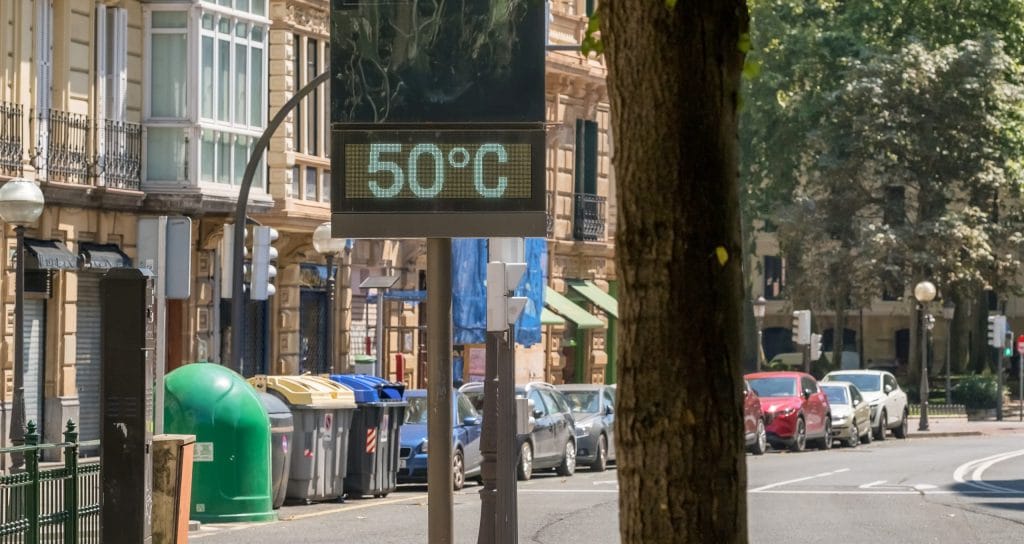
Smart cities need smart heat stress monitoring
Created by the United Nations Environment Programme (UN Environment) and the World Meteorological Organization (WMO) in 1988, the Intergovernmental Panel on Climate Change (IPCC) has the task to provide policymakers with scientific assessments on climate change, its implications and potential future risks, as well as to put forward recommendations on how to mitigate these risks.
In its “Climate Change 2022: Impacts, Adaptation and Vulnerability” report, the IPCC focuses on the risks climate change poses to cities, their population and everyday life. This is a global concern: over half of the world’s population lives in cities, and by 2050, that number is expected to rise to more than two-thirds.
But cities are not just affected by climate change. They also suffer from the urban heat island effect, where built-up areas experience significantly higher temperatures than nearby rural zones.
In fact, according to the UK Green Building Council, some city areas can be up to 12°C warmer than their surrounding countryside as buildings, roads, and other man-made materials absorb and retain heat far more effectively than natural green areas.
Why Heat Stress is an Urban Problem
Heat stress is a growing threat to public health. Urban residents, particularly older populations, face heightened risks during heatwave events. Research from the US Environmental Protection Agency (EPA) shows that the average rate of heatwaves has tripled since the 1960s, while data from the Centers for Disease Control and Prevention (CDC) indicates that around 2,000 Americans die each year from heat-related illnesses.
Beyond health, urban heat stress impacts productivity. Studies project that labour capacity could fall by up to 20% in hot months by 2050, especially in cities where outdoor work is common.
Extreme heat can also disrupt cultural and sporting events, affecting athlete performance, spectator safety, and event logistics.
Why Real-Time Heat Stress Monitoring is Critical
The risks of extreme heat go beyond human health and have significant impact on buildings, bridges and roads, transport and other essential services.
Heat also accelerates material degradation and structural damage:
- Roadways can soften and deform, requiring more frequent maintenance.
- Concrete and rail tracks can expand and buckle, increasing the risk of accidents.
- Bridges and pipes can suffer heat-induced expansion that can cause leaks or structural damages.
Recent events highlight these challenges. At the 2025 Wimbledon Championships, record-breaking temperatures of 32.3 °C prompted emergency cooling measures for players and fans. With the 2026 FIFA World Cup approaching, similar concerns are already prompting host cities to plan heat mitigation strategies.
To effectively protect citizens and infrastructure, real-time heat stress monitoring must become a core feature of smart city management.
How Gill’s GMX552 Supports Smart Cities
MaxiMet GMX552 is the world’s first compact weather station to integrate heat stress measurement. Developed in accordance with ISO 7243-2017, it measures black globe temperature, wind speed and direction, air temperature, humidity, and pressure, calculating Wet Bulb Globe Temperature (WBGT) in real time.
Engineered for durability and minimal maintenance, the MaxiMet GMX552 delivers a long operational life and low total cost of ownership. Its ability to operate via battery or solar power makes it ideal for deployment across for urban environments, supporting city planners, event organisers, and emergency services in safeguarding both people and infrastructure from the growing risks of extreme heat.
MaxiMet GMX552 also collects live, auditable data that can be integrated into public data feeds, enabling informed decisions that protect and support health and safety of citizens.
Resources
- IPCC – Cities, Settlements and Key Infrastructure
- Climate Change Indicators: Heat Waves | US EPA
- As climate change worsens, evidence links extreme heat and mental illness
- 2025 Heat Mortality Report | Environment and Health Data Portal
- As much of the US braces for extreme heat, statistics show 2,000 die from it annually – ABC News