

Sensors built for UAV performance. No moving parts. No compromises.
Every gram counts. Every drop of fuel matters. Gill Group builds the precision level, position and wind measurement technology that UAV manufacturers specify when the platform cannot afford sensor failure, and the weight budget cannot afford anything unnecessary.
UAV development does not have edge cases. It has a design brief.
High vibration, extreme temperatures, constrained installation geometry and weight budgets with zero margin. Every one of these is a standard condition on an unmanned airframe, not an exceptional one.
Off-the-shelf sensors are built for flexibility. UAV platforms demand precision under pressure. They are weight-critical, vibration-intensive, temperature-extreme systems where a sensor that almost works is a sensor that does not.
The difference between a sensor specified for UAV and one adapted for it shows up in service. Usually at the worst possible moment.
Weight is the constraint
Every component added to the airframe costs payload, range or endurance. There is no neutral addition. Gill sensors use titanium and carbon fibre where mass is critical. We can select from a range of materials to help meet specific weight targets.
Standard tank geometry is rarely what UAV designers get
UAV fuel tanks are shaped around airframe architecture, not around sensor catalogues. Standard top-down mounting is frequently not possible. Gill engineers custom probe angles, side-wall installations and bespoke geometries to match the specific installation.
Dead bands are not acceptable
Automotive fuel sensors leave unmonitored sections at the base or top of the tank. LevelLite variants are specified to the millimetre so every measurable volume can be tracked. For irregular tank shapes, Gill's tank profiling converts level output to accurate volumetric data regardless of geometry.
Vibration degrades mechanical sensors. It does not affect ours.
No floats. No moving parts. No mechanical wear accumulating over the aircraft's service life. Solid-state capacitive technology maintains accuracy across thousands of flight hours without recalibration or component replacement.
Precision measurement across the full UAV system.
Level sensing, position sensing and wind measurement from one UK supplier.

LevelLite
Custom length, custom geometry, custom mounting
All built from Gill's facility in Lymington. LevelLite uses solid-state capacitive technology with no moving parts, calibrated to the specific fluid type and tank geometry of the platform it is built for.
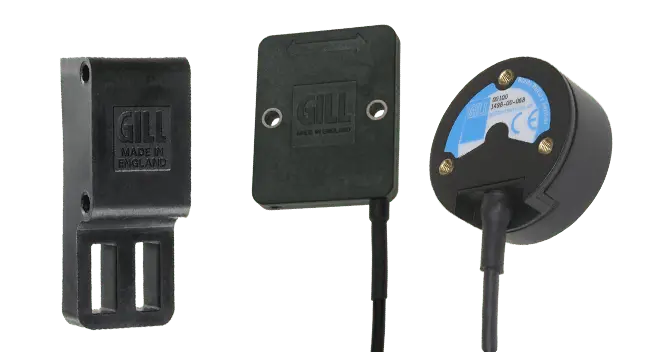
Blade Series
Non-contact induction position sensing
Non-contact induction position sensors for actuation feedback, control surface monitoring and engine management. No mechanical wear. No drift over service life. Fully sealed against dust, moisture and temperature extremes.

WindUltra
Accurate local wind before and during operations
WindUltra provides the ground-level wind picture that mission planning and launch decision-making depend on, in a compact, versatile mountable form factor.
What this looks like in the field.
Penguin B world endurance flight
The brief was continuous, accurate fuel level monitoring across a 54.5-hour flight in a 7.5-litre tank with an irregular geometry that ruled out standard top-down mounting.
Gill developed a custom side-wall mounted probe sealed to IP68 and weighing 60g. It monitored fuel accurately across the full flight duration, breaking the previous small-class UAV endurance record by 43%.
60-degree angled probe, six-week delivery
Where top-down mounting was blocked by surrounding components, Gill engineered a 60-degree angled probe monitoring the full tank depth from the side wall.
Total sensor weight: 80g. The design was developed, manufactured and delivered from Lymington in six weeks.
Custom fuel level sensing for minimum mass
Where the weight budget allows almost nothing and the tank geometry matches no standard design, Gill delivered a custom sensor built to the specific installation.
Off-the-shelf alternatives were not viable options, not close seconds.
Sensors for VTOL and autonomous air vehicles
As VTOL platforms move from prototype to production, Gill's custom engineering capability works from programme inception with OEMs specifying sensors for configurations that are being defined as the airframe develops.
Problems standard product catalogues cannot address.
Irregular tank shapes, side-wall mounting, angled probes, extreme mass constraints, accelerated delivery timescales. Gill engineers have solved UAV installation problems for military programmes, commercial OEMs and emerging platform developers.
Custom sensors are designed, manufactured and delivered from Gill's facility in Lymington. Prototype to OEM production volumes.
From prototype to production volume.
Where catalogue sensors stop, our engineering starts. Probe geometry, mounting arrangement, materials, output protocol and certification path all open to specification. The team that designs the prototype is the team that manufactures the production run.
Custom-engineering options
- Angled probesAny geometry, any angle
- Side-wall mountWhere top-down is blocked
- Ti & carbon fibreFrom 48g total weight
- Prototype to productionSingle facility, single team
- Defence and militaryCustom specs, accelerated timescales
Specifying sensors for UAV programmes.
UAV fuel level sensors may use capacitive technology. A probe inserted into the fuel tank measures the continuous change in electrical capacitance as the fuel level rises or falls. Gill's LevelLite outputs a direct analogue signal calibrated to the specific fluid type and tank geometry of each installation.
LevelLite probes are specified to the millimetre based on tank depth and installation geometry. This maximises the monitored range within the tank that other solutions are unable to detect. For irregular tank shapes, Gill produces custom tank profiling that converts level output to accurate volumetric data.
Yes, and it is not an unusual request. Where top-down installation is not possible, Gill engineers have developed angled and side-wall mounted configurations to specification. The 60-degree angled probe developed for an autonomous helicopter programme is one example.
LevelLite is rated to IP68 and operates across a temperature range of −40°C to +125°C. Sensors have been designed to fit into demanding applications where they see high shock and vibration conditions. Titanium and carbon fibre components are available where minimum mass is the primary constraint.
Yes. Gill level and position sensors have been used in military and defence UAV programmes including world endurance record flights. Custom designs, bespoke geometries, specific project requirements and accelerated delivery timescales are all available.
Probe weights start from 48g using titanium and carbon fibre construction. For weight-critical platforms, Gill engineers design around the primary constraint, whether that is mass, accuracy, vibration or EMC.
Yes. Gill's custom engineering capability operates from programme inception through to series production. The same facility in Lymington that develops the prototype sensor manufactures the production volume.
Six reasons UAV programmes choose Gill.
UK designed and manufactured from a single facility
The team that specifies the sensor is the team that manufactures it.
No moving parts across the entire sensor range
Solid-state measurement. No wear, no calibration drift, no maintenance intervals.
Custom capability that solves problems catalogues cannot
Non-standard geometries, angled probes, side-wall mounting, bespoke probe lengths.
Proven in world-record and defence applications
The Penguin B world endurance flight. Military surveillance platforms.
Full group capability from one supplier
Level sensing, position sensing, wind measurement, R&D consultancy and UKAS-accredited calibration.
Forty years of precision measurement
Part of a group that also supplies Formula 1, offshore energy, defence and global marine networks.