

The engineers behind every Gill product.
Gill Research & Development is the innovation team that has shaped four decades of measurement firsts. From the original ultrasonic wind sensor in the 1980s to the latest infrared optical rain gauge in 2026, every product we make starts here.

A family business built on deep technical expertise.
Gill began in 1984 with a single idea: measurement instruments without moving parts. Four decades on, and now spanning four group companies, that founding principle still defines how we operate. Gill R&D remains the engine room, where engineers combine fundamental physics with practical product design, taking concepts from first principles through to high-volume manufacture, all from a single UK site.
That continuity is deliberate. The same team that designs each sensor also defines the production process, resolves field challenges, and develops the next generation. There is no disconnect between R&D and delivery. Just one team, accountable for getting it right.
Four capabilities. One development cycle.
Every Gill product moves through the same four stages, run by the same in-house team. No outsourced design houses. No contract test labs sitting between us and the customer.
Technology research
At product inception, the R&D team runs deep-dive investigations to find the right physics for the application. Ultrasonic time-of-flight, capacitive measurement, optical sensing, electromagnetic detection. We pick the technology that survives the environment, not the one that fits the schedule.
Product design & implementation
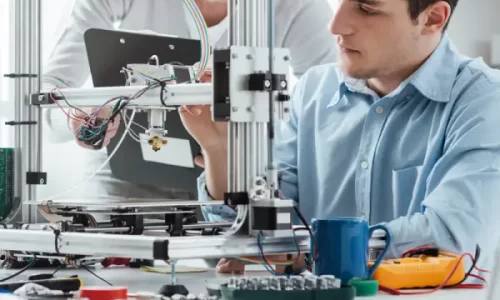
In-house electronics, embedded software, mechanical design and industrial design under one roof. Rapid prototyping moves concepts to working hardware in weeks. Every component decision is owned by the engineers who will support it for its lifetime.
Testing & certification
On-site environmental, mechanical and electrical test capability, complemented by accredited external labs for ATEX, IECEx, CSA, EMC and IP-rating certifications. Products are tested against real-world failure modes before they ever reach a customer.
Transition to manufacture
R&D works directly with our UK production team to take new products from pilot run to high-volume manufacture. Design for manufacture is built into the brief from day one, which is why Gill products ship reliably and perform consistently across long product lifecycles.
The technical disciplines behind the product range.
Decades of focused work in a small number of physical measurement domains. Each one has produced products that lead their market.
Ultrasonics
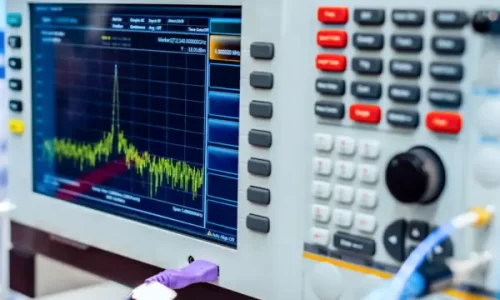
Ultrasonic time-of-flight measurement sits at the heart of every Gill wind sensor. Four decades of refinement on transducer design, signal processing and algorithm tuning has produced anemometers specified by national meteorological services worldwide.
Capacitance
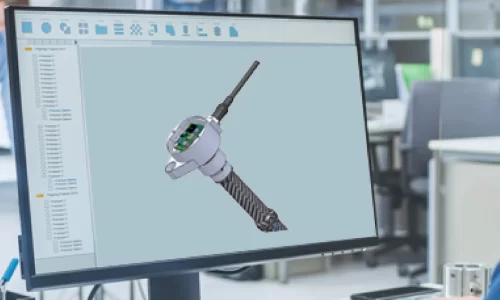
Capacitive measurement underpins the Gill Sensors and Controls level sensor range. Used in Formula One fuel measurement, UAV fuel sensing and off-road military vehicles where mechanical floats simply cannot survive.
Electromagnetics
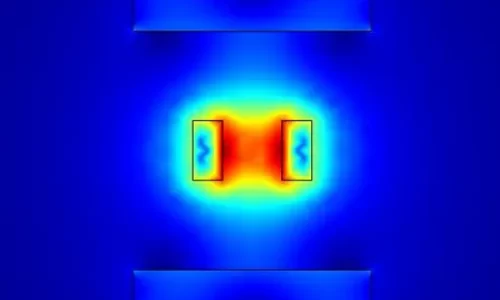
Non-contact position and motion sensing using electromagnetic detection. Lightweight, solid-state, and built for environments where contact-based sensors are a liability rather than an asset.

Optical sensing
The newest technology in the Gill stack. Infrared optical detection for precipitation measurement, removing the funnels, tipping buckets and blocked drains that have plagued rain gauges for centuries.

Software
Real-time embedded software, mobile apps and PC applications all running on Gill-designed systems. Linux, embedded real-time operating systems and bare-metal as appropriate. Configurable, field-upgradable and supported by Gill engineers, not third-party firmware vendors.
Mechanical & industrial design
Stainless steel for marine, aluminium for weight-critical aerospace, ATEX-certified enclosures for hazardous areas. The shape of a Gill instrument is engineered, not styled, with airflow modelling and mechanical resilience driving every design choice.
Three products. Three measurement firsts.
A snapshot of how Gill R&D translates fundamental research into products that change their markets.
Ultrasonic anemometry, no moving parts
Gill was among the first to commercialise ultrasonic wind measurement. By measuring time-of-flight rather than counting cup rotations, the technology removed the wear and maintenance points that had defined wind sensors for a century.
Explore wind range →FIA-homologated fuel flow meter for Formula 1
When the FIA introduced fuel flow regulation for the 2014 season, Gill became the only approved supplier of the measurement device used to enforce it. Ultrasonic technology applied where measurement accuracy under extreme conditions is non-negotiable.
Visit Gill Sensors & Controls →Infrared optical rain gauge
The latest measurement first from Gill R&D. Optical precipitation measurement that ignores blockages, requires minimal maintenance, and resolves down to drizzle. Designed for unattended weather networks where mechanical gauges quietly fail.
View TruMet →
Decisions grounded in real-world performance.
Gill remains an independent, family-owned British manufacturer. The engineers who design our products also shape the decisions behind them, guided by how those products perform in the field. That closeness to real-world application ensures consistency, accountability and solutions that perform where it matters most, and products that customers trust in critical environments.
Read the Gill story →Have a measurement problem you need solving?
Gill R&D is increasingly working as a dedicated engineering partner for organisations that need expert sensor and instrumentation development. The same team that has shaped four decades of Gill products across ultrasonics, capacitance, electromagnetics and optical sensing is available for client projects where catalogue products do not fit the brief.
Bring us a measurement challenge, a sensor physics problem, or a custom instrument requirement. We will work it through with you, from feasibility study to working prototype to manufacture-ready design.
Discuss a project →Bespoke sensor development
Ultrasonic, capacitive, electromagnetic and optical measurement systems engineered for your application.
Software & firmware
Real-time embedded software, mobile apps and PC applications. Linux, embedded real-time operating systems or bare-metal as appropriate, supported long-term.
Manufacture-ready design
Design for manufacture from day one. Prototype to production with the same UK engineering team.
Why in-house R&D matters.
Six things that change when the engineering team is in the same building as the production line and the support desk.
Faster problem solving
Field issues come back to the original designers. No third-party design house. No multi-week escalation chain. The engineer who built the sensor sees the data within hours.
Long product lifecycles
Some Gill products have been in service for fifteen or twenty years. That kind of longevity only happens when the same team designs, supports and evolves them for the long term.
Sovereign UK supply
Design, software, manufacture and test all in the UK. For programmes where supply chain provenance matters, that is a procurement requirement, not a marketing claim.
Genuine product evolution
Roadmaps driven by what customers actually need, not what is easiest to ship. Heat stress, optical rain and intrinsically safe variants all started as customer conversations.
Cross-pollination across the group
Wind sensor signal processing informs level sensor algorithms. Position sensor electromagnetics inform anemometer design. Four group companies sharing one engineering bench compounds the expertise.
Direct technical support
When you call Gill, the engineer on the other end can usually point at the schematic of the product on their desk. That is not normal in this market. It should be.